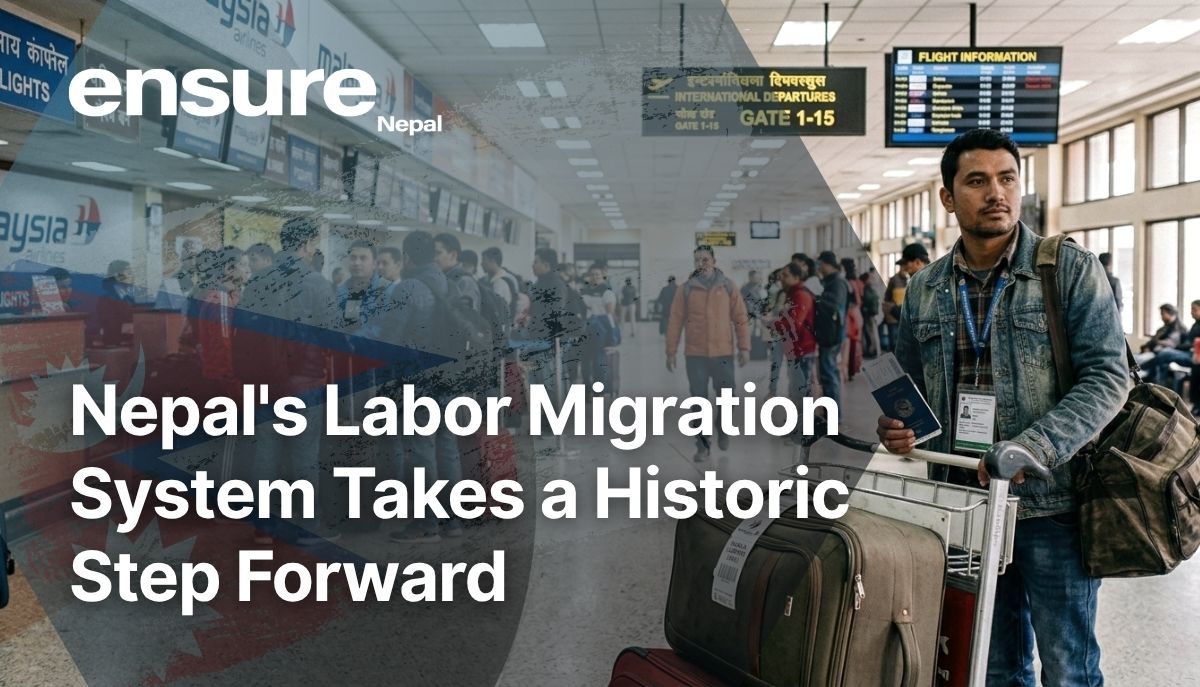
The ENSURE Center of Excellence Signing Ceremony Marks a Turning Point for Migrant Worker Protection
On April 9, 2026, in Kathmandu, Nepal, something years in the making finally happened: representatives from key agencies involved in labor migration signed their names to a new standard: Centers of Excellence (CoE) that will adopt and apply higher, international standards for migrant worker recruitment, health exams, and pre-departure training.
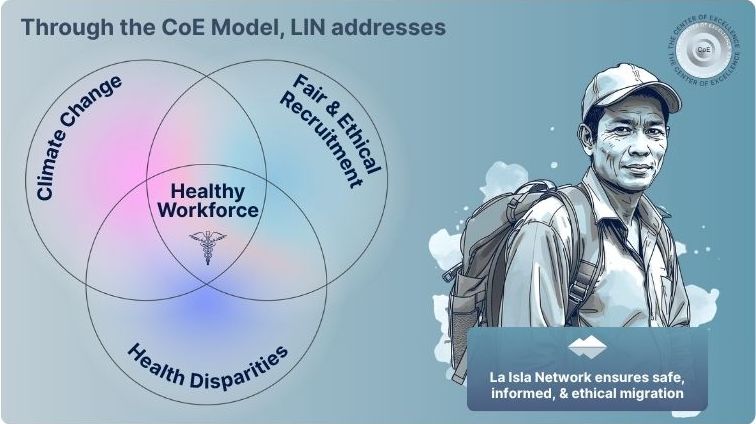
Through the Enhanced Network for Safety and Occupational Health Utilization and Risk Evaluation (ENSURE-Nepal) Project, the launch of Centers of Excellence marks the official beginning of the intervention phase of La Isla Network’s (LIN’s) effort to reduce forced labor and occupational illness and injury among Nepali migrant workers.
For the workers this project is designed to protect, those signatures represent more than a commitment on paper. They signal a coordinated effort to make migration safer, more transparent, and more accountable.
Why Nepal, Why Now
Every year, hundreds of thousands of Nepali workers leave the country in search of work, many headed to the Gulf Cooperation Council countries where construction, domestic work, and service industries rely heavily on migrant labor. Before they can board a plane, most workers must pass through a fixed set of checkpoints: a recruitment agency, a health screening clinic, and a pre-departure orientation training (PDOT) provider. These are legal requirements.
In practice, that system often falls short. Across the migration journey, there is significant variation in the quality, consistency, and accountability of services provided for migrants. Recruitment costs can be higher than legally permissible, and information is not always transparent. Health screenings may not fully capture conditions that could pose serious risks in destination environments, and the quality of pre-departure training can vary. As a result, workers arrive in destination countries underprepared, under-protected, and with no recourse when things go wrong.
The consequences are severe. Research conducted through ENSURE at the National Kidney Center in Kathmandu confirmed what has long been suspected: returning Nepali migrant workers are experiencing kidney failure at alarming rates. In addition, a companion qualitative study, led by our partner the Nepal Development Society (NeDS), documented that workers are frequently exposed to forced labor and other forms of exploitation while working abroad. Their accounts confirm the broader literature: these are predictable, preventable outcomes of a system that is not doing its job.
What the Center of Excellence Is
The Center of Excellence (CoE) is ENSURE’s answer to that system failure. Rather than working around these agencies, the CoE works with them, recruiting a group of recruitment agencies, health screening clinics, and PDOT providers that are willing to hold themselves to a higher standard and be held accountable for it.
The process of building the CoE has taken the better part of a year. It required the ENSURE team, led on the ground in Nepal by LIN, NeDS, Pravasi Nepali Coordination Committee (PNCC), and Pourakhi Nepal, to build trust with agencies one by one: holding individual and group meetings, navigating complex negotiations, and bringing institutions along. Health screening centers, in particular, required careful relationship-building to secure their participation.
The signing ceremony formalized what that relationship-building had made possible. Each of the fifteen recruitment agencies, training providers, and health clinics that signed on committed to implementing a set of defined standards — standards developed by the ENSURE team through research and co-design. These standards are specific, measurable expectations that will be tracked through regular scorecards completed by both agency staff and the workers who pass through their doors.
What Comes Next
The signing ceremony marks the beginning of the most important phase of the work. Trainers will now deliver revised curricula to staff across all three types of partner organizations. These curricula are designed to align day-to-day practices with the standards required for CoE membership — strengthening the consistency and quality of health screenings, pre-departure training, and recruitment processes. Through this effort, staff will be supported in adopting more comprehensive approaches to worker preparation, including enhanced health assessments, deeper training on labor rights and cultural contexts, and recruitment practices aligned with international standards.
The workers who will move through Nepal’s migration system through the CoE will encounter a system that has been deliberately redesigned, with measurable standards, accountable institutions, and rigorous follow-up, with the goal of giving them a better chance of arriving healthier, better prepared, and equipped not just to know their rights but to exercise them when it matters. The signatures on April 9th mark the moment that commitment became official, and the moment ENSURE’s mandate to demonstrate with rigorous evidence whether systemic change in the migration pipeline can reduce forced labor moved from design to practice.
The People Who Made This Happen
Milestones like this one are easy to describe in aggregate. They are much harder to achieve.
The signing ceremony is the culmination of reviewing over a thousand research studies, conducting original field research, designing an intervention from the ground up, and then bringing a fragmented system of institutions into alignment around a shared standard. A multi-stakeholder collaboration—the NeDS team, a committed core of local agencies, colleagues at PNCC and Pourakhi, partners from Johns Hopkins University, Gothenburg University, and Bournemouth University, as well as leadership from LIN—demonstrated what sustained collaboration across civil society, academia, and industry can achieve when partners commit to long-term systems change.
For everyone who has worked on ENSURE since the beginning, the signing ceremony is proof that the approach works: that patient, rigorous, relationship-driven systems change is possible even in environments where the incentives have long pointed the other way.
The workers moving through Nepal’s migration system via the CoE may not know the name ENSURE. They will simply experience a system that treats them with more honesty, more preparation, and more care. And what ENSURE learns from that experience, about whether systemic change in the migration pipeline can reliably reduce forced labor, has implications well beyond Nepal’s borders.
La Isla Network is a research and advisory organization protecting workers from heat stress and environmental health risks worldwide. ENSURE is funded by the U.S. Department of State Office to Monitor and Combat Trafficking in Persons.

This project was funded by a grant from the United States Department of State, grant-SSJTIPS23CA0022. The opinions, findings, and conclusions stated herein are those of the author(s) and do not necessarily reflect those of the United States Department of State.