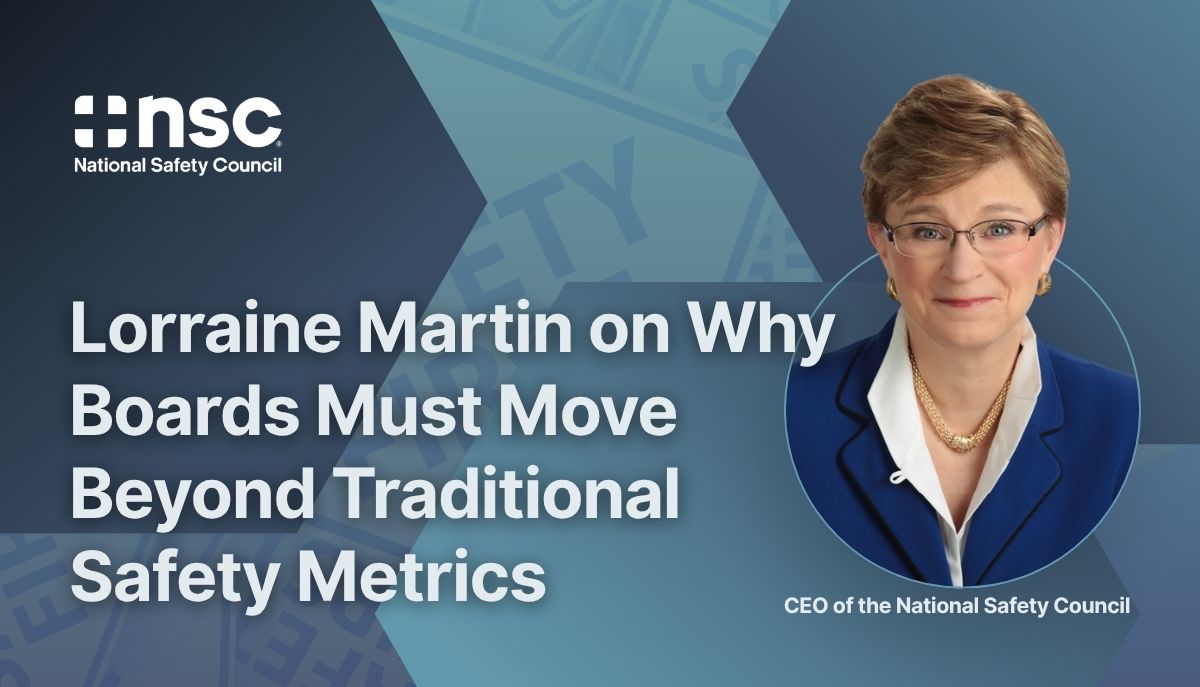
Lorraine Martin, CEO of the National Safety Council, spoke with La Isla Network about why workplace safety governance needs to shift from lagging metrics to leading indicators and Serious Incident and Fatality (SIF) prevention.
Q: What is the biggest misconception boards have about workplace safety today?
A: The biggest misconception is that the metrics companies have used for decades are giving boards the full picture of whether their organization is truly safe. Traditional metrics mostly count incidents, and that is important, but it does not tell leaders whether they have reduced risk in the workplace or addressed their highest hazards. Those measures treat very different events as if they are equivalent, so they can obscure the difference between minor injuries and the kinds of serious exposures that can lead to fatalities.
Q: Why has the conversation shifted toward leading indicators and SIF prevention?
A: Over time, organizations have succeeded in bringing down total recordable incident rates (TRIR), but fatalities have remained relatively stagnant across industries. That tells us the old metrics are not well correlated with the most serious outcomes. Over the last decade, the conversation has shifted toward identifying where the highest-hazard work exists, understanding what causes serious incidents and fatalities, and tracking whether those risks are being controlled.
Q: How do you explain SIF prevention in practical terms?
A: One helpful way to think about it is to look for energy in the workplace. Energy is often what causes serious harm to people, whether that is gravity, motion, impact, explosions, heat, or chemical reactions. Organizations need to identify where that energy exists, where it could be released, and what controls are in place to keep people safe when mistakes happen. Then they need to measure whether those hazards are being found, controlled, and verified.
Q: What does leadership on this issue look like in the boardroom?
A: It starts with asking better questions. Boards should ask whether the safety metrics they are reviewing actually show risk reduction or whether they are simply counting outcomes. Boards are already used to looking at leading indicators in other areas of business, such as staffing, training, supply chain resilience, and quality. Safety should be approached the same way. Directors should ask what is being measured that demonstrates risk is being reduced and whether management is identifying and controlling the highest-risk exposures in the organization.
Q: What is one practical question directors can ask right now?
A: A strong place to start is with the new ASTM E2920-26 standard for SIF identification and remediation. Directors can ask, ‘Are we using the ASTM standard, and if not, can you come back and tell us what it would mean for us?’ That question alone can open an important conversation about whether the organization is using current best practice to identify high-risk work and track how those risks are being managed.
Q: How can boards make sure controls are not just in place, but actually effective?
A: Controls need to be verified, not assumed. That can include audit and verification functions that assess whether a control really works when energy is released, whether people are sufficiently separated from the hazard, and whether the control redirects or contains the energy the way it is intended to. The key point is that prevention depends on both identifying the risk and confirming that the protective measures are actually effective.
Q: What does strong safety governance look like?
A: Strong safety governance starts when boards ask for leading indicators and ask questions specifically about serious incidents and fatalities. Leaders should ask: What are the things in our environment most likely to seriously hurt someone? Have we analyzed where high-energy exposure exists? What have we done to control it? Employees often know exactly which tasks feel most dangerous, so strong governance depends on management creating systems that surface those realities and act on them.
Q: For organizations just beginning this shift, what are useful first steps?
A: Start by identifying your high-risk exposures and then verifying controls. NSC offers a free, adaptable SIF prevention model built around planning, doing, checking, and acting. Organizations should also create a culture of ‘hazard hunting,’ where teams are encouraged to look for serious risks, identify the types of energy present in their workplace, and act quickly to control them. The point is to make serious risk visible and actionable.
Q: What does a successful prevention culture feel like?
A: It feels very different from a culture focused mainly on keeping recordable numbers low. In a SIF-prevention approach, the goal is to find as many high-energy hazard risks as possible, control them effectively, and verify those controls quickly. That means numbers may initially go up because people are reporting more hazards and speaking more openly about what could go wrong. But that is often a sign that the culture is becoming healthier and more honest about risk.
Q: How do you see the role of boards evolving from here?
A: Boards are increasingly recognizing that safety is part of business performance. A strong safety environment supports a more effective business because employees feel protected, operations are more stable, and organizations are better able to sustain performance. Boards are well positioned to connect safety with the broader risk-reduction lens they already use in governance and strategy.
Q: What is your call to action for directors?
A: Start the conversation around SIFs. Ask whether your organization is using the new ASTM E2920-26 standard. Elevate metrics that show proactive risk reduction, not just the lowest number of recordables. Prevention is a powerful business practice, and safety should be treated that way in the boardroom.
La Isla Network (LIN) develops and scales evidence-based, data-driven worker protection interventions that prevent heat-related injury, illness, and death. We combine rigorous health research with management-of-change processes and occupational safety protocols to improve workforce resilience and business continuity. LIN partners with governments and multilateral institutions to create practical, scalable protections for heat-exposed industries. LIN also provides, as appropriate, technical advice to governmental and non-governmental partners to support them in their efforts to translate research into policy and occupational health-related laws and regulations. For more information, please use our contact form.