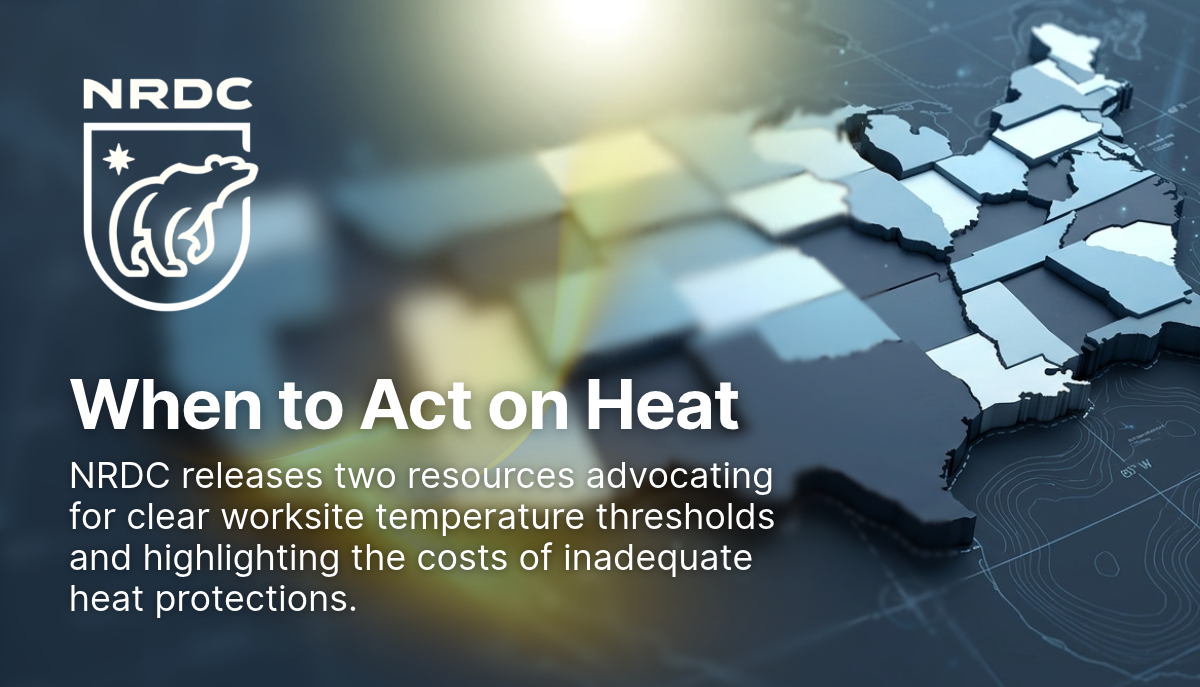
Two new resources from NRDC make the case for clear temperature thresholds at the worksite and show what heat costs workers when protections fail.
Most of the harm heat does to workers never reaches the official count. “Death and illness data is really hard to come by,” says Juanita Constible, Senior Advocate in the Environmental Health Program at the Natural Resources Defense Council (NRDC). “It tends to be very spotty, and it tends to underrepresent the problem.”
In October, NRDC released two resources that approach the problem from different directions. The first is a report that uses workers’ heat complaints in Nevada to test a common objection to heat rules: that no specific temperature can be set for when protections begin. The second is a nationwide story map, drawn from the enforcement records of the federal Occupational Safety and Health Administration (OSHA), of what heat does to workers when protections fail. We spoke with Constible and with Barrak Alahmad, an epidemiologist at the Harvard T.H. Chan School of Public Health and Senior Advisor for La Isla Network, who co-wrote the report.
A warning bell, and a starting point
“The complaints data gives us a sign of what workers are feeling before they get sick, before they get hurt,” Constible says. “It’s kind of like a warning bell. If workers are complaining at a certain temperature, they’ve probably been hot for a while, and the risk of illness and death is probably increasing.”
Alahmad puts it this way: “Heat complaints reveal unsafe conditions, like inadequate cooling or drinking water, that may never appear in injury or death records. They give us a chance to act before someone is seriously harmed.”
The report, What Happens in Vegas Should Inform the Rest of the Country, by Alahmad and Yazan Alwadi of the Harvard T.H. Chan School of Public Health with Constible, analyzed heat complaints and referrals to Nevada OSHA from 2015 to 2024. The odds of a complaint began rising at about 90°F air temperature (85°F heat index) and roughly doubled with every additional 5°F. The odds were about 7.5 times higher on a 105°F day than on a 90°F day.
The pattern held across industries. “We saw a similar rise in complaints across construction, warehousing and hospitality, despite very different working conditions,” Alahmad says. “That supports common minimum protections across industries, a finding we keep seeing in different datasets and with different methods.”
“We should use data to decide when heat protections begin,” he adds. “In Nevada, we showed an evidence-based starting point for action using complaints data from within the state.”
The data has limits, and Constible is clear about them. “It doesn’t tell us who got sick or who got hurt, and it’s only issues that came to Nevada OSHA’s attention. It leaves out workers in precarious employment situations, like migrant farm workers, and any worker who doesn’t know they have the right to submit a complaint to OSHA. So, it still only gives us a sliver of what workers are truly experiencing on the job.”
The report calls for state and federal heat standards with specific, data-driven temperature thresholds, including in states now considering new standards, such as Virginia and New Mexico. For employers, it recommends a comprehensive written heat illness prevention plan in place before the threshold is ever crossed, and training for workers and supervisors in a language and manner they understand.
The stories behind the records
NRDC’s story map collects selected cases of preventable heat-related harm from federal OSHA enforcement records. It builds on a University of Maryland capstone project by Danielle Gratz, and readers can sort the cases by state, economic sector and unsafe practice.
“Another case that has stuck with me is an oil and gas worker in Texas,” Constible says. “He fainted in the heat, but it wasn’t the fainting that killed him. It was the fact that he fractured his skull and his ribs. How many times has a worker had an injury that could have been prevented with heat protections? There are actually lots of cases like that in the OSHA database, like workers slipping off hot tar roofs or hitting their head on a piece of equipment, fracturing their cheek, breaking their ankle. I think it’s much more common than we realize.”
The cases reach well beyond the jobs most often linked to heat. “Heat is a much bigger problem than just construction or farm work,” she says. “Not to say that those workers aren’t most at risk, because we know they are from a bunch of different sources, but this is a much broader, economy-wide problem that can affect anyone, from doing cashier work to putting up a bridge.”
The harm doesn’t stop with the worker who is hurt. “It must take a toll on workers who find their coworkers in distress or dead,” Constible says. “I don’t think we’ve really grappled with the mental health implications of these climate-related hazards getting worse, and more and more workers being forced to see these things happen.”
The map is built for telling stories, not for counting. “It should not be used to compare states against other states, because the level of OSHA enforcement varies radically by state, depending on whether the state is under federal or state control, on local priorities and a bunch of other things,” she says. “It’s also not useful for saying this is the true number of workers affected by heat in this state.”
Used that way, the stories carry weight. “At one point, I was testifying in front of the Pennsylvania House, and I saw a couple of committee members visibly flinch when I told them a story from this. There’s real power in these stories, and I hope the map will inspire a broader array of storytelling and less reliance on top-line numbers that we know are flawed.”
NRDC’s story map lets readers sort heat-related OSHA cases by state, economic sector and unsafe practice. Tool by: NRDC.

Protection is a plan everyone follows
As E&E News reported in July 2024, Gabriel Infante was 24 and in his first days on a job digging trenches in San Antonio’s 100-degree heat when he became confused. His supervisor assumed he was on drugs and called the police. He was dying of heatstroke, with a body temperature of 109.8 degrees. His mother, Velma, has said she was shocked the government had no protocol to keep people from dying of heat at work.
Preventing deaths like his takes more than a single rule. “We know from the many tragedies that have happened that there’s not usually one thing that leads to a worker’s serious illness or death. It’s usually a cascade of failures,” Constible says.
A plan also has to hold on ordinary days. “Heat protection on the job is never just about the hottest days. It’s about the daily grind of heat hazards that workers can face, even in what seem like relatively normal conditions,” she says. “And although there may [be] a plan on paper, it’s often not followed.”
“You want to avoid the worst-case scenario, and that’s where training and a plan come in. But you need to be ready to address the worst-case scenario if it happens, and that’s where proper first aid procedures come in, such as cooling first, transporting second.”
We turned NRDC’s Story Bank into an interactive visualization. 397 workers, ten summers, one pattern.
What comes next
In 2027, Constible will work on Virginia’s heat rulemaking, support the rulemakings in New Mexico and Washington State, and follow federal OSHA’s proposed rule. “I really think we are barely brushing the surface when it comes to the harms workers face on the job from heat,” she says.
La Isla Network makes a related case: guidance on when to act on heat should come from field data and be tested in real operations. LIN CEO Jason Glaser sets out that roadmap in Alliance magazine.
Links
- Read the report: What Happens in Vegas Should Inform the Rest of the Country
- Explore NRDC’s story map
- Jason Glaser in Alliance magazine
About La Isla Network
La Isla Network is an independent, research-driven occupational and public health organization that protects workers and communities in a changing climate, wherever heat and other hazards put their health at risk. From recruitment and contracting to the worksite, the home, and the clinic, we work across supply chains with employers, workers, and governments to advance protection and performance together. We combine field research, industrial hygiene, and organizational change to assess risk, develop and evaluate protections, and make them hold at scale, so workers stay healthy and businesses and communities thrive. For more information, please reach out using the contact form.