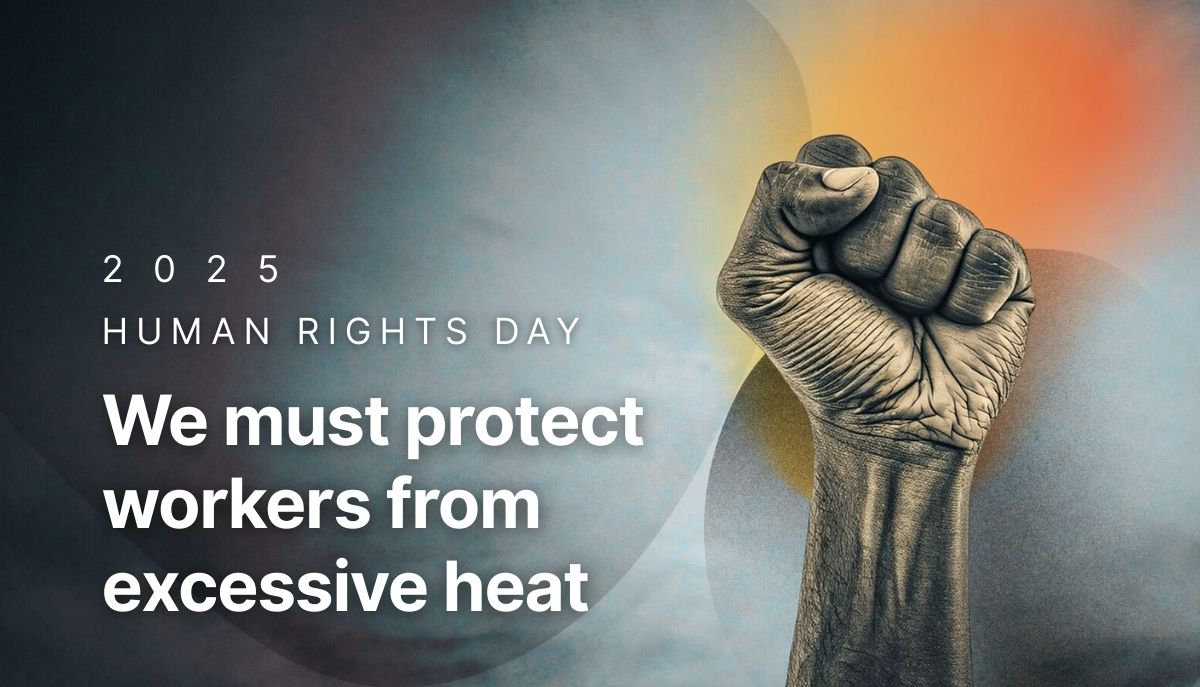
This Human Rights Day 2025, La Isla Network (LIN) is making a clarion call to protect workers worldwide from exposure to excessive heat. We remember that the right to the highest attainable standard of health includes the right to safe, humane working conditions. No one should have to risk their life trying to provide for their families.
Rising temperatures worldwide threaten millions of workers’ right to safe and dignified work. Compounding this problem, too many businesses are still inadequately prepared to protect their workforces, facing outdated guidance, patchwork regulations, and a lack of data.
LIN is proud to position itself as a leader in the fight against excessive heat in the workplace. Our worker- and business-conscious solution has shown a 94% reduction in heat-related kidney injury hospitalizations, a 9–19% increase in worker productivity, and a 60% return on investment in heat protections by year three.
The human rights of workers figure squarely in LIN’s solution. We work at the intersection of research, law, policy, and advocacy to ensure that the human-rights implications of heat stress are not ignored and to push for concrete protections that save lives and make business sense.
Occupational heat stress is a public-health emergency threatening the rights of workers
The good news: occupational heat stress is predictable and preventable. However, without essential protections guaranteed by workers’ rights to life and health, they face acute harms like heatstroke, injury, and death. Workers also face long-term risks like chronic kidney failure.
In many countries, including the United States and in Europe, these harms add up to thousands of preventable deaths and hundreds of thousands of injuries each year, concentrated among the workers who are most at risk.
Treating these harms as a human rights issue matters. The right to the highest attainable standard of health—enshrined in the Universal Declaration of Human Rights and reflected in international treaties and national constitutions—is intrinsically connected to the right to life, security of person, equality, and freedom from degrading treatment.
As such, domestic laws, policies, and regulations that remove or weaken basic protections for workers risk breaching binding international human-rights law obligations, not merely failing on occupational-health policy and standards.
Fortunately, LIN’s outcomes demonstrate that humane, evidence-based protections save lives while making economic sense for employers and communities. These include structured rest, shade, water, heat-aware work schedules, and worker participation and monitoring. We help workers stay healthy, businesses resolve risk, and governments meet compliance.
Policy and legal clarity: why this matters now
Some recent policy shifts have undercut protections that previously reduced heat-related harm. At the same time, proposed agency thresholds and guidance in some settings fail to account for core-body-temperature risk and workload intensity.
Where law or policy reduces access to water, shade, or rest, workers’ rights to health and life—and protections against inhuman or degrading treatment—are jeopardized.
LIN has raised these concerns in formal submissions to international and regional treaty bodies and to U.S. policymakers to ensure that heat-related harms are treated as human-rights violations as well as failures in occupational safety and health.
A call to act now: LIN’s human rights-based, evidence-driven agenda
On Human Rights Day 2025, LIN calls on three groups to take immediate, concrete steps:
- Governments and multilateral organizations. Promote and protect the right to occupational safety and health and other related human rights in law, policy and practice. Adopt enforceable, evidence-based protections for workers exposed to heat, strengthen inspection and enforcement, and fund centers of excellence and surveillance systems.
- Employers and supply-chain partners. Implement worker-centered protocols today: guarantee potable water, shade and adequate rest; adjust workloads and schedules when heat risk rises; participate in independent monitoring; and adopt clear remediation measures when protections fail.
- Funders. Invest in implementation research, monitoring systems, workforce training, and the scaling of proven interventions — including support for centers that can translate research into operational guidance.
We propose an agenda that centers six interlinked lines of action for these groups (among others):
- Enforceable legal protections. Support stakeholders in their efforts to codify access to potable water, shade, mandatory rest breaks and workload adjustments into law and regulation, with triggers and thresholds guided by physiological evidence rather than arbitrary ambient figures.
- Centers of Excellence (CoEs). Establish national and regional centers to develop and disseminate evidence and human and labor rights-based protocols, train practitioners and support local implementation.
- Improved labor practices and corporate accountability. Embed worker-centered heat protections into supply-chain standards and workplace human and labor rights-based codes of conduct, accompanied by transparent monitoring and remediation mechanisms.
- Technology and data integration. Deploy practical monitoring tools and integrated data systems that identify risk in real time and inform adaptive protections.
- Better occupational health reporting. Modernize health information systems to recognize and classify heat-related workplace illnesses that are often invisible so policy, compensation and prevention systems can function.
- People-centered communications. Combine technical evidence with worker testimony and lived experiences to build the public and political will needed for durable change.
How LIN can help
LIN brings technical expertise, programmatic experience, and a human rights-based policy framework to support governments, employers, funders, and multilateral organizations.
We design and implement pilot programs, provide training and tools for monitoring and evaluation, and advise—as appropriate and permitted by donors and domestic laws—on legal and policy reform to align domestic measures with international human-rights and public-health norms and standards.
Our practical, evidence-driven approach helps turn commitments on legal and policy documents into protections that work in the field.
We invite partners to work with LIN to pilot scalable interventions, strengthen surveillance and reporting, and develop enforceable policies, laws and regulations that protect workers’ lives and dignity.
About LIN
La Isla Network (LIN) develops and scales evidence-based, data-driven worker protection interventions that prevent heat-related injury, illness, and death. We combine rigorous health research with management-of-change processes and occupational safety protocols to improve workforce resilience and business continuity. LIN translates research into policy by partnering with governments and multilateral institutions to create practical, scalable protections for heat-exposed industries. For more information, please use our contact form.